Abstract Method Retrieval Results Downstream Tasks Acknowledgements BibTeX
WACV 2027

SignSeek: Learning Transferable Representations for Sign Dictionary Retrieval

Sobhan Asasi1,  Ozge Mercanoglu Sincan1,  Richard Bowden1

1CVSSP, University of Surrey, United Kingdom

Paper arXiv Code Coming soon

Sign dictionary retrieval with SignSeek. Given only a query video of an unknown sign, SignSeek ranks the entries of a sign dictionary by embedding similarity and returns the top matches, with no fine-tuning on the dictionary.


Abstract

Sign language dictionaries are essential resources for sign language learners, yet automatically retrieving a sign from a dictionary, given only a query video, remains a challenging problem due to the natural variability between signers. Existing sign representation learning methods are built for closed-set recognition, producing embeddings that do not generalise to the open-set, signer-independent setting that retrieval demands. SignSeek closes this gap by contrastively learning sign representations with saliency-guided articulator masking. A contrastive objective aligns same-gloss signs across signers, while our Articulator Saliency-Guided Masking (ASGM) pinpoints the single most critical articulator per sign. This drives two complementary objectives, a masked contrastive alignment (MAC) loss that sees the sign through a single articulator and a masked prediction (MAP) loss that reconstructs it in latent space from the surrounding spatio-temporal context. Pretrained on 266K samples (~5,700 glosses) across multiple sign languages, SignSeek sets a new state-of-the-art performance in cross-corpus retrieval on ASL-Citizen, WLASL, and NMFs-CSL without any downstream fine-tuning. Strikingly, it achieves zero-shot generalisation to an entirely unseen British Sign Language (BSL), surpassing methods explicitly trained on BSL, and transfers seamlessly to isolated sign recognition and subtitle alignment, outperforming prior skeleton-based methods.


Method

SignSeek framework overview

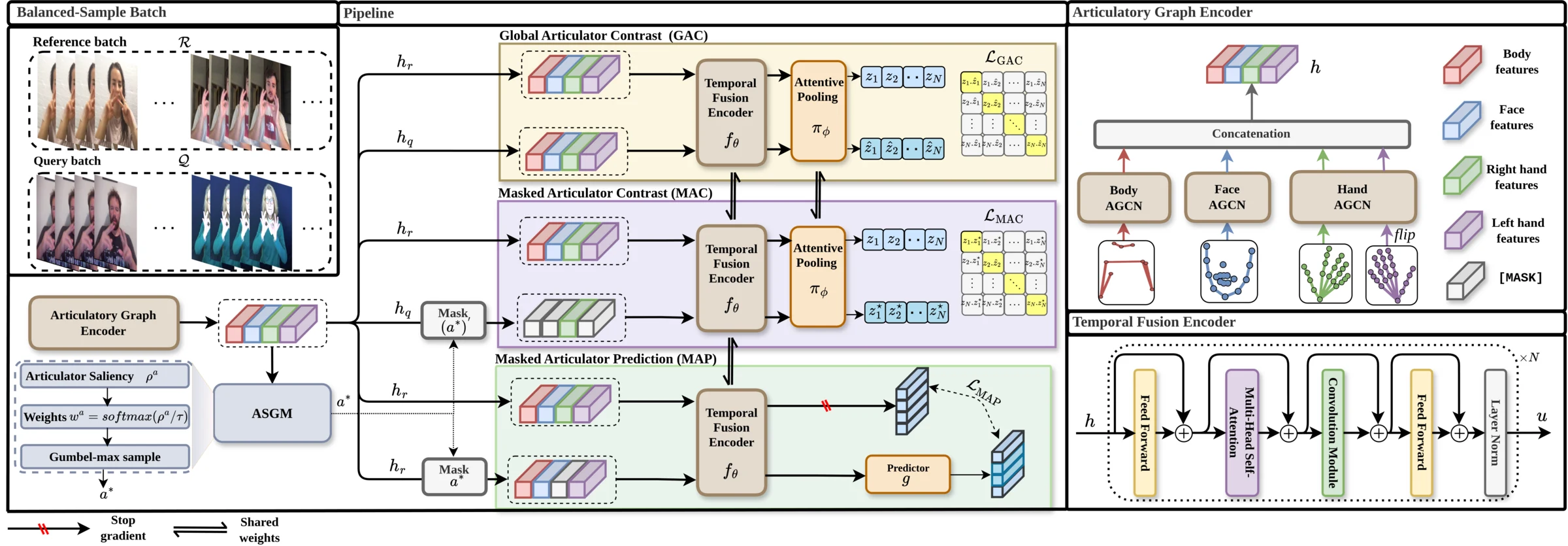
Fig. 1 — Overview of SignSeek. A balanced-sample batch of query and reference clips is encoded per articulator by the Articulatory Graph Encoder, fused by a Conformer and pooled into a single embedding. GAC contrasts intact embeddings, MAC aligns a query seen only through its dominant articulator with clean same-gloss references, and MAP predicts the clean representation of a clip whose dominant articulator is masked. ASGM selects that dominant articulator per clip.

Articulatory Backbone: Pose In, One Embedding Out

Per-Articulator Graph Encoders 2D keypoints are split into body, face, left hand and right hand. Each stream is encoded by its own adaptive graph network; the two hands share an encoder, with the right hand mirrored so both live in a common canonical frame.
Temporal Fusion Encoder The concatenated articulator streams are fused by a Conformer and pooled by attention into a single L2-normalised clip embedding, used directly for retrieval by cosine similarity.

ASGM: Articulator Saliency-Guided Masking

Which Articulator Carries the Sign? Saliency is read from the encoder itself: the norm of each articulator's standardised, temporally pooled embedding. No auxiliary supervision and no learned parameters.
Gumbel-Max Selection A temperature-scaled softmax turns saliency into a distribution, and one dominant articulator is sampled per clip, keeping the saliency ordering in expectation while preserving variety.

Three Objectives: Through and Without the Dominant Articulator

Global Articulator Contrast (GAC) A supervised contrastive loss over intact clips pulls same-gloss signs from different signers together, shaping the signer-invariant space that retrieval demands.
Masked Articulator Contrast (MAC) Keeps only the dominant articulator of the query and aligns it with clean same-gloss references, forcing the most salient articulator alone to be gloss-discriminative.
Masked Articulator Prediction (MAP) Masks the dominant articulator and predicts the clean Conformer representation in latent space from the surrounding context, capturing the structural dependencies between articulators.
Sign Dictionary Retrieval

57.7%
R@1 on ASL-Citizen
+7.7 over SignRep, zero-shot
65.2%
R@1 on NMFs-CSL
+2.2 over SignRep, zero-shot
12.8%
R@1 on unseen BSL
+3.6 over Video-Swin, trained on BSL

Cross-Corpus Retrieval — No Fine-Tuning

Features Pre-training (Scale) ASL-Citizen WLASL2000 NMFs-CSL
DCG ↑R@1 ↑R@5 ↑ DCG ↑R@1 ↑R@5 ↑ DCG ↑R@1 ↑R@5 ↑
Image / video pre-trained features
HieraMAEKinetics-400 (700 h)11.640.250.8413.212.083.4023.293.9612.18
HieraMAEYT-SL-25 (3,000 h)12.120.391.3414.062.574.4128.037.5718.38
I3DBSL-1K (273 K)13.320.632.0617.063.416.8125.826.3416.03
Video-SwinBOBSL (5,500 K)27.217.5519.3836.8413.9733.3965.3143.9771.62
Pose / keypoint features
All Joint Angles–13.820.572.1717.922.546.5032.517.9325.50
All Keypoints–14.290.982.7419.373.168.2336.6412.2630.99
Hand Keypoints–25.917.9619.5828.117.5720.9241.7215.9142.62
Hand Joint Angle–26.938.8121.4130.619.4224.3644.1718.1346.34
Learned sign representations
SignCLIPSpreadthesign (456 K)21.804.0011.4222.105.2511.7851.2026.7553.03
MASA4× ISLR sets (146 K)49.3127.9649.7836.98†14.38†32.63†74.94†54.69†83.27†
SignRepYT-SL-25 (3,000 h)71.2149.9580.0957.9329.9267.4183.0563.0495.63
SignSeek (Ours)5× corpora (266 K)77.2157.6686.6761.2434.7570.2585.1765.2096.79

No method is fine-tuned on the evaluation datasets, which are unseen during pre-training except where marked † (MASA includes WLASL and NMFs-CSL). SignSeek is pretrained on five sign corpora across four languages, none overlapping the evaluation sets. The best result in each column is in the highlighted SignSeek row; the second best is underlined. Scale is in hours (h) for continuous-signing corpora and thousands of clips (K) for isolated-sign sets.

Qualitative Retrieval — Top-1 Match

Top-1 dictionary entry retrieved for each query sign. SignSeek returns the correct gloss across signers, while Video-Swin and SignRep often retrieve visually similar but wrong signs.

Zero-Shot British Sign Language Dictionary Lookup

We query 726 BSL signs, performed by a native signer, against the public BSL SignBank dictionary. SignSeek never saw BSL during pre-training, yet it beats Video-Swin, which was trained on BSL.

ModelInput#Params (M)BSL seen? R@1 ↑R@5 ↑mAP ↑
I3DRGB13.4✓0.552.221.67
SignCLIPPose109.4✗1.023.052.85
SignRepRGB51.5✗4.3012.628.72
MASAPose68.2✗6.8015.4011.57
Video-SwinRGB49.5✓9.1516.7813.37
SignSeek (Ours)Pose15.7✗12.76 (+3.61)29.54 (+12.76)20.84 (+7.47)

#Params: parameters of the frozen feature extractor. BSL seen?: whether the backbone observed British Sign Language during pre-training. No method is fine-tuned on SignBank.


Downstream Tasks

Sign–Subtitle Alignment with a Frozen Encoder

Sign-subtitle alignment with SignSeek

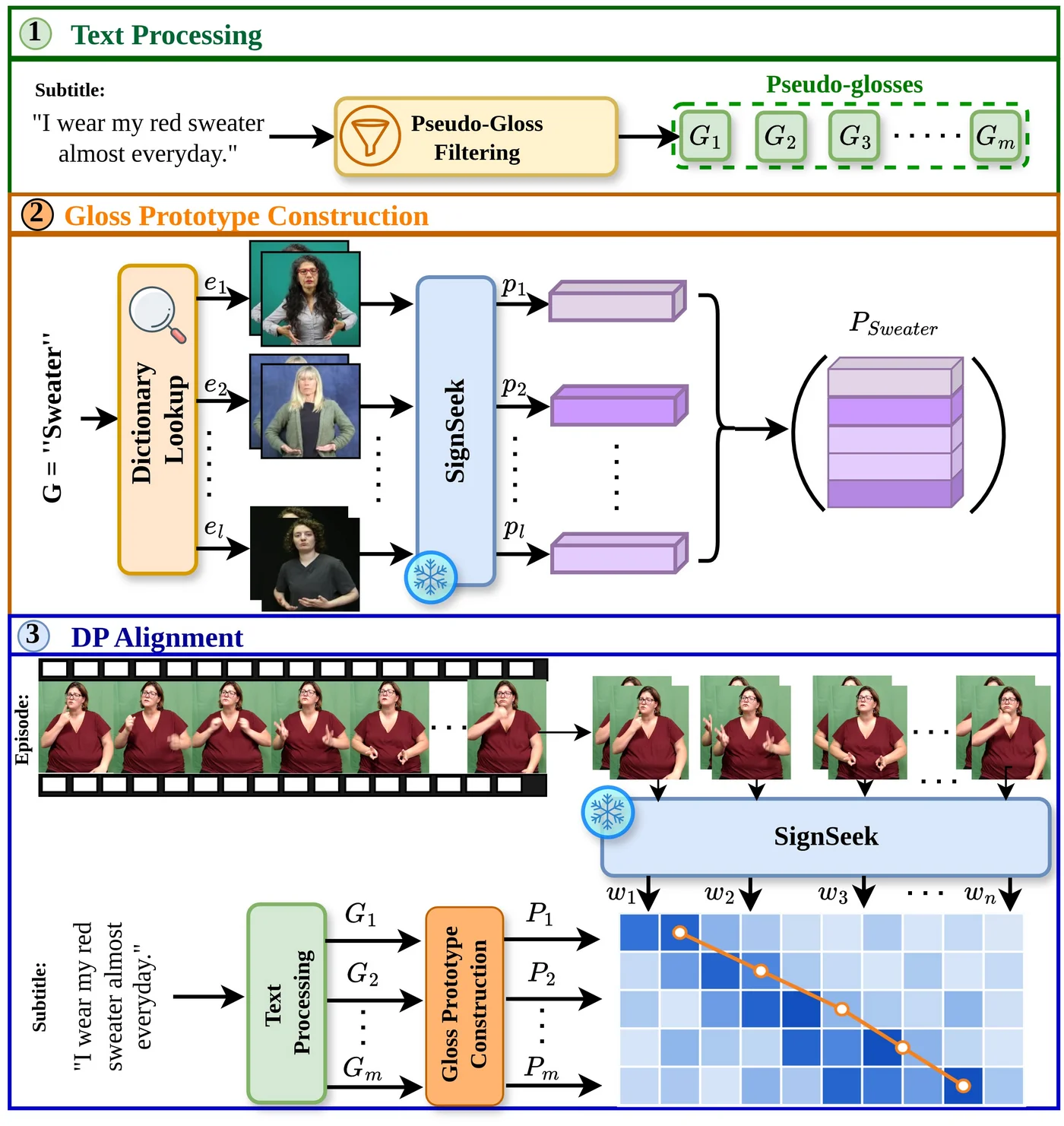
Fig. 2 — A subtitle is filtered into pseudo-glosses (1), each looked up in a language-matched isolated-sign dictionary and encoded by the frozen SignSeek encoder into a prototype bank (2). The same encoder embeds the episode windows, and a monotonic path through the gloss-to-window similarity matrix is decoded by dynamic programming (3).

Method How2Sign BOBSL
ValTestValTest
Static baselines
Original (audio-based)30.6333.0629.0914.11
Original* (fixed offsets)31.9136.2149.6344.61
Segment and align
Segmentation33.3836.1766.2449.58
Segmentation-BSLCP––63.6147.75
Segment, embed, and align
SignCLIP35.5137.5166.7050.68
Dictionary-guided alignment
SignSeek36.5140.2066.9450.72

Sentence-level temporal alignment accuracy (F1@0.5 ↑) on How2Sign and BOBSL. SignSeek is trained from pose with gloss labels only, with no alignment-specific training.

Isolated Sign Recognition with Fine-Tuning

Method WLASL NMFs-CSL ASL-Citizen
Top-1 ↑Top-5 ↑ Top-1 ↑Top-5 ↑ Top-1 ↑Top-5 ↑
Skeleton-based
ST-GCN34.4066.5759.986.859.5282.68
SignBERT39.4073.3567.095.3––
BEST46.2579.3368.594.4––
SignBERT+48.8582.48––––
MASA49.0682.9071.797.0––
SignCLIP––––60.084.0
SignSeek56.6587.6773.898.874.794.0

ISLR accuracy after adding a classification layer and fine-tuning the pretrained encoder (per-instance accuracy on WLASL). SignSeek is the strongest skeleton-based method on all three datasets, +7.6 Top-1 over MASA on WLASL and +14.7 over SignCLIP on ASL-Citizen.


Acknowledgements

This work was supported by EPSRC grant APP24554 (SignGPT — EP/Z535370/1), EPSRC grant APP78083 (UMCS — UKRI3927), and through funding from Google.org via the AI for Global Goals scheme. The authors acknowledge the use of Isambard-AI National AI Research Resource (AIRR), funded by UK DSIT via UKRI and STFC [ST/AIRR/I-A-I/1023].


BibTeX

@article{asasi2026signseeklearningtransferablerepresentations,
      title={SignSeek: Learning Transferable Representations for Sign Dictionary Retrieval},
      author={Sobhan Asasi and Ozge Mercanoglu Sincan and Richard Bowden},
      year={2026},
      archivePrefix={arXiv},
 }