Quantitative Results
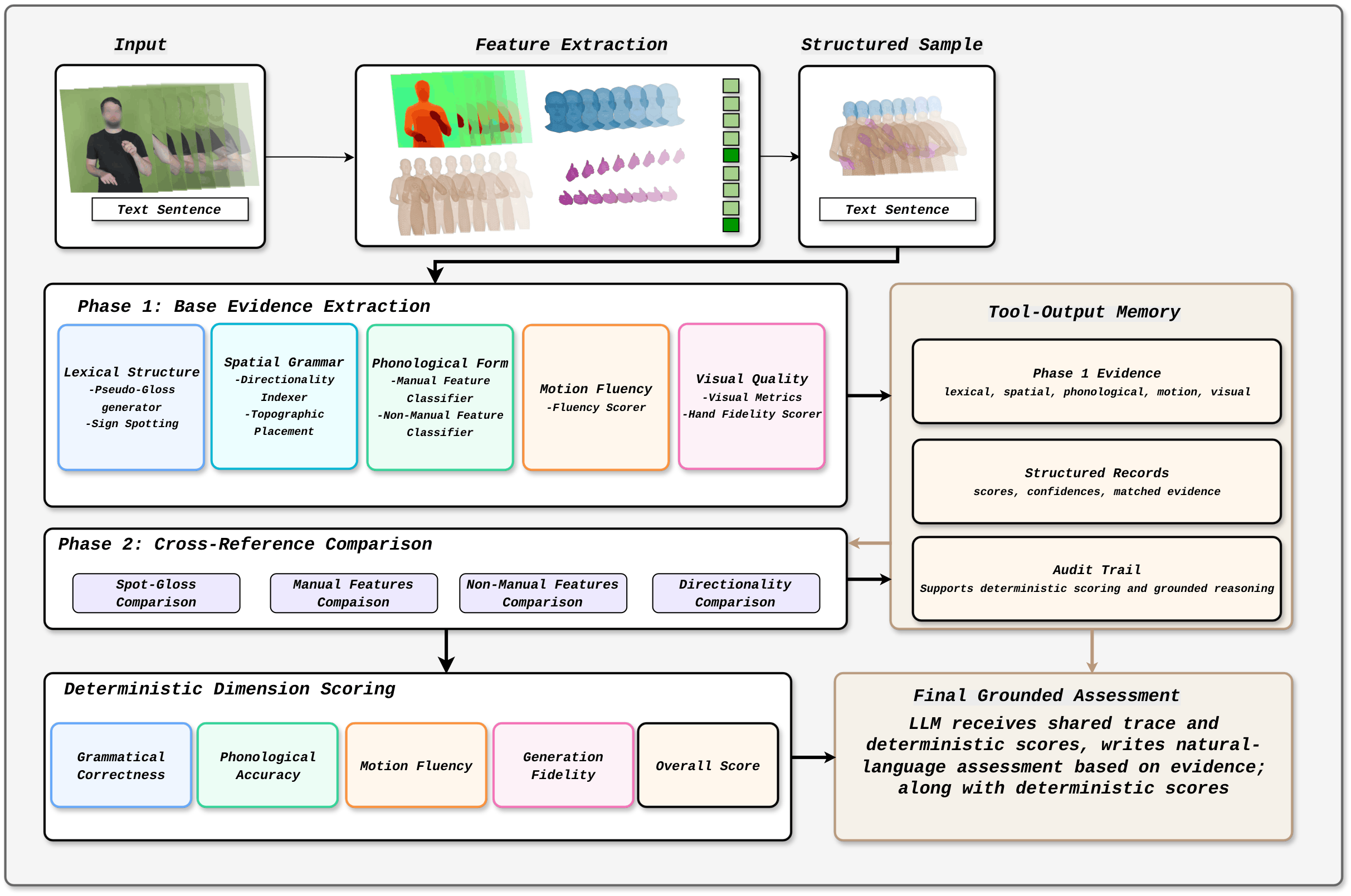
We evaluate on four complementary benchmark subsets spanning real signing, controlled corruption, synthetic production, and targeted spatial-grammar evaluation. The table below compares BT2 with reference-free and reference-based baselines using direction-normalised Pearson r / Spearman ρ against human judgements — higher values always indicate stronger alignment.
Evaluation Benchmark
| Subset |
Content |
Purpose |
| Human SRT |
6 signers × 6 sentences |
Proficiency variation |
| Known Corruptions |
6 sent. × 6 sign. × 3 corrupt. |
Anomaly sensitivity |
| Synthetic Productions |
6 production systems |
Production-method evaluation |
| Directionality / Topography |
Targeted spatial-grammar set |
Grammatical placement |
Metric – Human Alignment (Table 3)
| Method |
Known Corr. |
Synthetics (Under.) |
Synthetics (Qual.) |
Human SRT |
| r | ρ |
r | ρ |
r | ρ |
r | ρ |
| DTW-MPJPE |
0.91 | 0.50 |
−0.14 | −0.03 |
−0.33 | −0.37 |
0.04 | 0.00 |
| SiBLEU |
−0.58 | −0.50 |
0.03 | 0.31 |
−0.05 | 0.31 |
0.96 | 0.90 |
| SignCLIP p2p |
| BSL sentence |
−0.97 | −1.00 |
0.85 | 0.90 |
0.82 | 0.70 |
0.69 | 0.80 |
| BSL segmentation |
−0.55 | −0.50 |
0.75 | 0.70 |
0.63 | 0.60 |
−0.46 | −0.40 |
| Multilingual sentence |
0.85 | 1.00 |
0.70 | 0.70 |
0.55 | 0.60 |
−0.10 | −0.40 |
| Multilingual segmentation |
−0.59 | −0.50 |
0.83 | 0.70 |
0.75 | 0.60 |
−0.30 | 0.00 |
| SVAE |
0.95 | 1.00 |
0.43 | 0.26 |
0.54 | 0.31 |
0.81 | 0.80 |
| BT1 |
| BLEU-4 |
−0.19 | 0.00 |
−0.38 | −0.44 |
−0.15 | −0.10 |
0.00 | 0.00 |
| BLEURT |
0.09 | 0.50 |
−0.35 | 0.03 |
−0.39 | −0.09 |
0.15 | 0.35 |
| ChrF |
−0.87 | −1.00 |
−0.27 | −0.09 |
−0.54 | −0.37 |
−0.15 | −0.35 |
| ROUGE |
−0.19 | 0.00 |
−0.34 | −0.44 |
−0.08 | −0.10 |
0.00 | 0.00 |
| SignCLIP p2t |
| BSL sentence |
0.25 | 0.50 |
0.03 | 0.30 |
0.17 | 0.40 |
0.56 | 0.60 |
| BSL segmentation |
−0.25 | −0.50 |
−0.33 | −0.30 |
−0.20 | −0.10 |
−0.78 | −0.70 |
| Multilingual sentence |
0.89 | 0.50 |
−0.64 | −0.60 |
−0.41 | −0.30 |
−0.07 | −0.10 |
| Multilingual segmentation |
0.77 | 0.50 |
−0.37 | −0.10 |
−0.50 | −0.30 |
−0.11 | −0.30 |
| BT2 Overall (ours) |
1.00 | 1.00 |
0.42 | 0.60 |
0.52 | 0.66 |
−0.43 | −0.30 |
| BT2 Phonology |
0.28 | 0.50 |
0.48 | 0.26 |
0.35 | −0.03 |
0.87 | 0.90 |
| BT2 Grammar |
−1.00 | −1.00 |
−0.50 | −0.14 |
−0.45 | −0.26 |
−0.45 | −0.60 |
| BT2 Fluency |
0.28 | 0.50 |
0.21 | 0.37 |
0.40 | 0.54 |
−0.46 | −0.40 |
| BT2 Fidelity |
0.80 | 1.00 |
0.74 | 0.94 |
0.83 | 0.94 |
−0.81 | −0.90 |
| Gwet's AC2 |
0.69 | 0.69 |
0.68 | 0.69 |
| ICC(2,1) |
−0.02 | 0.51 |
0.35 | 0.07 |
| Within-1 agreement |
0.74 | 0.79 |
0.78 | 0.75 |
| Quadratic weighted κ |
−0.03 | 0.46 |
0.35 | 0.09 |
| Handshape flag α |
0.24 | 0.26 |
0.26 | 0.09 |
| Non-manual flag α |
0.27 | 0.29 |
0.29 | −0.03 |
| Word-order flag α |
0.30 | 0.01 |
0.01 | −0.01 |
BT2 Overall achieves perfect correlation (r = 1.00, ρ = 1.00) on Known Corruptions — matching or exceeding the strongest reference-based alternatives while requiring only source text. BT2 Phonology reaches ρ = 0.90 on Human SRT where proficiency shows through articulatory form; BT2 Fidelity is strongest on Synthetic productions (ρ = 0.94). All values are direction-normalised so higher always indicates better metric–human alignment.
Corruption Sensitivity — Synthetic BSL Corpus (Table 5)
Per-dimension win rates on n = 180 synthetic BSL corpus corruptions (uncorrupted BT2 ≥2.5), conditioned on which classifier fires. Columns measure overall score plus per-dimension scores; rows are corruption type. Bordered cells mark the overall score and the matched target dimension for each corruption.
≥80%
65–79%
55–64%
wrong-way
| Corruption |
n |
Overall |
Phon. |
HS |
Loc |
Gram |
Flu. |
Fid. |
| Handshape | 138 |
76% |
73% |
86% |
75% |
60% |
28% |
65% |
| Location | 129 |
75% |
76% |
82% |
74% |
61% |
52% |
59% |
| Word-order | 134 |
73% |
73% |
82% |
73% |
83% |
42% |
66% |
| Temporal | 121 |
79% |
71% |
79% |
75% |
60% |
55% |
66% |
| Fidelity | 137 |
74% |
73% |
85% |
73% |
60% |
26% |
64% |
| Handshape | 87 |
69% |
68% |
87% |
98% |
57% |
22% |
62% |
| Location | 93 |
68% |
72% |
83% |
95% |
61% |
51% |
62% |
| Word-order | 88 |
78% |
73% |
88% |
94% |
56% |
47% |
64% |
| Temporal | 78 |
75% |
67% |
87% |
96% |
51% |
51% |
69% |
| Fidelity | 88 |
65% |
64% |
85% |
97% |
59% |
27% |
66% |
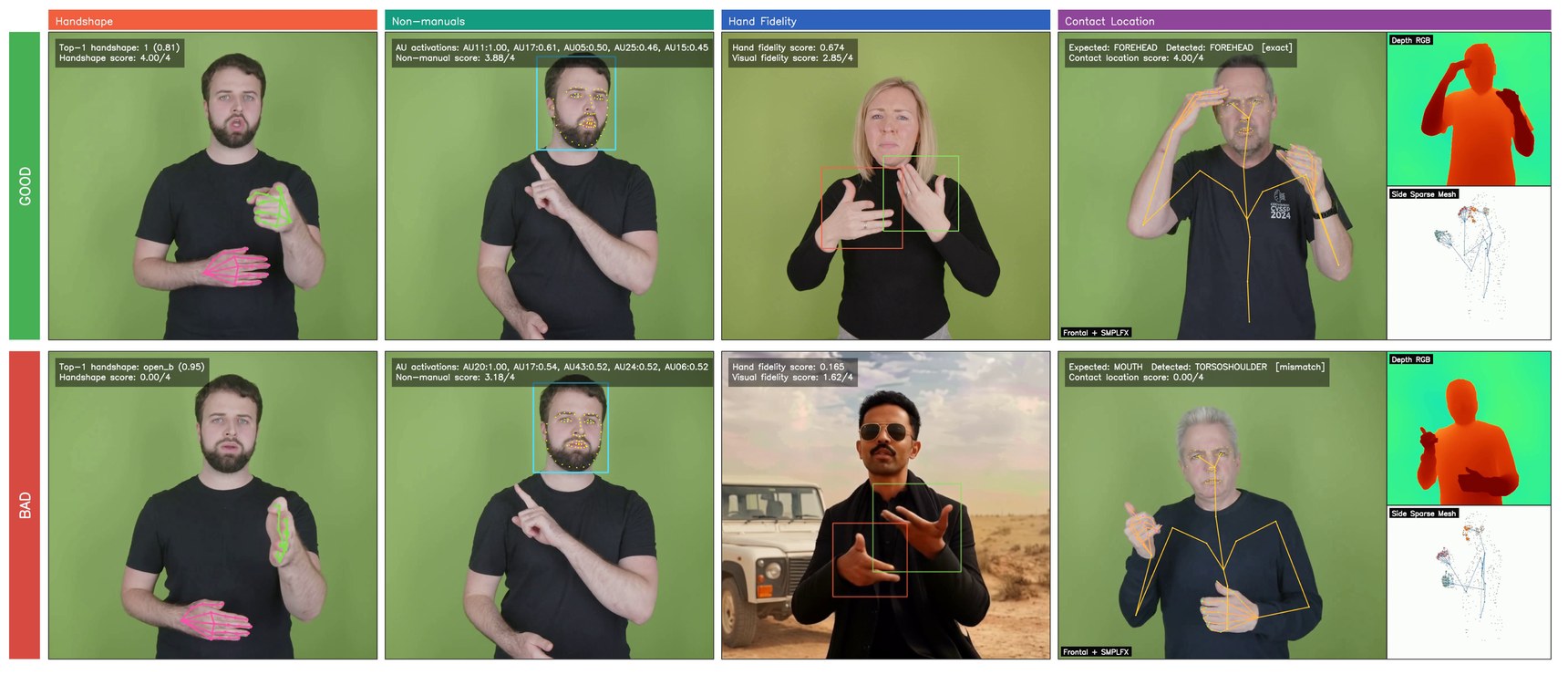
BT2 correctly localises each corruption to its target dimension across all five corruption types (overall win rate 65–79%). Fluency is deliberately wrong-way for handshape and fidelity corruptions — these alter phonological form without disrupting motion, confirming BT2 does not over-penalise unaffected dimensions.
Sentence-level Directional Predictions (Table 6)
Directional-verb evidence extracted by the directionality comparison tool across clause pairs. Bold words are directional verbs; green pronouns are extracted grammatical-person entities; arrows (1 → 2) denote predicted agreement direction between person loci (1 = 1st, 2 = 2nd, 3 = 3rd person). NDV: no directional verb.
| Sentence |
Predicted |
Matches GT |
| I will help you learn some signs but you can ask him |
1 → 2, 2 → 3 |
✓ |
| I will help you learn some signs but I can ask him |
1 → 2, 1 → 3 |
✓ |
| I will help him learn some signs but you can ask him |
1 → 3, NDV |
✓ |
| She will help you learn some signs but he can ask me |
NDV, 1 → 3 |
✓ |
| I will help you learn some signs but you can ask him |
NDV, NDV |
✓ |
Across all clause pairs, extracted person-locus sequences match the intended directional patterns, illustrating that the directional stack captures clause-conditioned role transfer rather than only surface motion similarity.